
According to Merrill Lynch (BofA-ML) report, Domestic capital markets are likely to remain volatile in the September-November period due to factors like US Fed's policy action, second quarter corporate earnings and Bihar state elections.

Superseding the boards of two non-banking financial companies (NBFCs) in the Srei group will neither create liquidity challenges for sound entities, nor build systemic crises because the markets have factored in the problems with the Kolkata-based firms. Such regulatory steps will help in making the NBFC space more robust, bankers and market experts said. The action should have begun earlier because the Reserve Bank of India (RBI) had done a special audit last financial year and asked the group to make provisions for assets considered stressed, analysts said.

After outperforming the broader market and their public sector peers for the better part of the post-Lehman period, private sector banks - such as HDFC Bank, ICICI Bank, Axis Bank, and Kotak Mahindra Bank - are now underperforming. Last week, the Nifty Private Bank index was up just 6 per cent year-to-date in the calendar year 2021, against nearly 13 per cent rally in the Bank Nifty and a 15 per cent rise in the benchmark Nifty50. Public sector (PSU) banks, such as State bank of India, Bank of Baroda, and Punjab National Bank, are now rally leaders and outperforming the broader market. The Nifty PSU Bank index was up 42 per cent since the beginning of this calendar year. But on a longer term, the Nifty Private Bank index is up 101 per cent since March 2016, against a 118 per cent rally in the Bank Nifty and just 2 per cent rise in the Nifty PSU Bank index in the period.

RRBs were formed under an Act to provide credit to small farmers, agricultural labourers and businesses in rural areas.

Punjab National Bank is the second largest PSU bank, in which government holding is 58.87 per cent.

While India won't be immune to global spillovers, we need to create the macro preconditions for sustained growth. Policy agility, prudence, and resilience will be key, suggests Sonal Varma.

The 30-share Sensex gained 271 points to end at 28,805 and the 50-share Nifty ended up 84 points at 8,712.

While Gupta, 60, can rightfully bask in the glory he has achieved for his bank in the subcontinent, his peers in foreign banks will have to revisit their India play, especially the local incorporation model, says Raghu Mohan.

Loan against gold as a product is catching on fast. Let's keep the momentum going, but aim for sustainable growth. A few bad apples should not ruin the brunch, argues Tamal Bandyopadhyay.
At a time when banks are engaged in a fierce battle to gain market share in the credit card segment, Citibank India has been losing its share, both in terms of outstanding cards and spends in the last few years. Still, average spends on Citi cards are higher than any other Indian bank. Last year, the global banking behemoth announced exit from its consumer banking franchises in 13 markets across Europe, Middle East and Asia, including India, citing lack of scale.

The International Monetary Fund (IMF) warned on Tuesday that India's general government debt (comprising both central and state government debt) could exceed 100 per cent of gross domestic product (GDP) in the medium term. It also cautioned that long-term debt sustainability risks are high due to the significant investment required to meet India's climate change mitigation targets. The Indian government, however, disagreed, arguing that risks from sovereign debt are extremely limited as it is predominantly denominated in domestic currency.

Flush with liquidity, banks are eager to lend. And, therein lies the problem, warns Tamal Bandyopadhyay.

Fresh plans of privatisation or divestment in central public sector enterprises and public sector banks might take a back seat this financial year because these may require a large consensus among coalition partners.
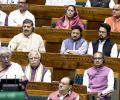
Finance Minister Nirmala Sitharaman on Tuesday announced income tax relief for the middle class, a Rs 2 lakh crore outlay for job creation schemes over the next five years and a spending splurge for states run by her party's new coalition partners as she unveiled the Modi 3.0 government's first budget after the general elections.

The main issue has been that of a higher Asset Management Ratio as has been prescribed by the Monetary Authority of Singapore for qualifying full banks from India.

Rogue lending under political influence was rife in the Congress-led regime and is not happening in the Modi regime, certainly not on that scale. But if PSBs cannot lend as indiscriminately as they did last time in the name of 'credit expansion', how well will these banks do, asks Debashis Basu.

The Survey also said that the borrowings by banks have increased significantly.

'The private sector believes that some enablers in labour-intensive sectors like apparel, toys, tourism, and media retail, can unlock a lot of jobs.'

One smells a rat when cases are settled for too small a price offered either by the highest bidder or the promoter -- within and outside the legal ambit of insolvency process, observes Tamal Bandyopadhyay.

Few finance ministers announce any taxation measure that could upset the stock market. Ms Sitharaman decided to take that risk, observes A K Bhattacharya.

Equity benchmark Sensex climbed 248 points to close at its all-time high on Tuesday, tracking unabated foreign capital inflows amid a positive trend in global markets. After a see-saw session, the 30-share BSE Sensex climbed 248.84 points or 0.40 per cent to settle at 61,872.99 -- surpassing its previous closing peak of 61,795.04 on November 11. During the day, the index witnessed a high of 61,955.96 and a low of 61,436.90.

This growth gives sleepless nights to a bank chairman

Auto stocks are weighing on the indices.

The 30-share Sensex surged 299 points to close at 28,736 and the 50-share Nifty gained 90 points to end at 8,723.

Reliance Industries was the top gainer in the Sensex pack, surging over 3 per cent, followed by Bajaj Finserv, IndusInd Bank, HDFC twins and Kotak Bank. NSE Nifty surged 143.25 points or 1.18 per cent to 12,263.55.

Is the worst over for Indian banks? The past two years saw them ride on treasury trades as deposits soared and credit growth dipped sharply. Gross and net non-performing assets (NPAs) moved south, and the provision coverage ratio (PCR), capital buffers, and profitability indicators are back at pre-pandemic levels. So, what's the plot ahead?

The polls are being viewed as a run-up to the general elections scheduled for May 2019 and will test the popularity of the government and its policies amid rising crude oil prices

'When you do some job for a few hours, you are hardly earning enough to survive.'

A key demand is to reduce the dividend distribution tax on listed firms.

'We have a plan to plough back a 'This year in the first half we had profits of more than Rs 31,000 crore.' significant amount of profits this financial year.' 'We have seen this organic plough back of profit is one of best ways to support the equity of the bank.'

The banking sector's credibility is on thin ice. Unless the government takes strict steps, things could get worse.

Banks are set to sell dud-loans worth Rs 90,000 crore of 22 firms in the first tranche to the National Asset Reconstruction Company (NARCL). It's reason for cheer given that such sales to asset reconstruction companies (ARCs) have been poor in recent times. In fiscal 2020, their assets under management (AUM) contracted by 4 per cent; and in fiscal 2021, it fell by another 100 basis points to Rs 1.07 trillion. So, why are we where we are?

'This segment has performed very well for us and this is reflected in our bounce rate which is about three to four per cent.'

Assuming we still have a Modi-led majority government after May 2024, there is no guarantee that reforms will move at anything more than a snail's pace, though we must be thankful even for that, notes R Jagannathan.
S Viswanathan is the new managing director of State Bank of India's associates and subsidiaries.

The Sensex closed higher by 170 points at 26,128 and the Nifty rose 59 points to end at 7,943.

Sensex eneded 374 points higher on rate cut expectation from the RBI.

Emerging markets facing 5th year of slow growth: World Bank.
Advice to the new finance minister from former RBI governor Raghuram Rajan: 1. Clean up banks by reviving projects that can be revived after restructuring debt. 2. Improve governance and management at public sector banks. 3. De-risk banking by encouraging risk transfers to non-banks and the market. 4. Reduce the number and weight of government mandates for public sector banks, and for banks more generally.
 © 2026 Rediff.com - Advertise with us - Disclaimer - Privacy Policy - Sitemap - Feedback - About us - Terms of use - Grievances